Monday, December 5, 2011

Why "What Is Up" Has Been Down ...

.....I have not had a post go up since September for a couple of reasons that I wanted to share with you (though this is an aberration - the whole point of this blog is the sky, not me).  At the end of September, I had a bicycle accident that resulted in a hairline fracture of the S4 vertebra, which led to a couple of weeks of intense pain, which was much worse at night.  At the same time, my work situation became extremely negative, a full-fledged cautionary tale about the total lack of protection the worker has without a union.

.....In any event, the continuing evolution of a look for the monthly star map is coming very soon, and I will also begin looking toward the transit of Venus across the face of the Sun on June 5th, 2012.  It will be possible to actually watch the disk of the planet Venus cross the Sun.  This is definitely something to try to see, since we won't be able to see this happen again until December of 2117!

Friday, September 16, 2011

The September Sky

.....This blog has not been updated in an uncharacteristically long stretch because of personal pressures with the beginning of a new school year, and my move to a new house, with an actual backyard - a backyard that has a line-of-sight to zero streetlights, instead of the eight at the apartment!  I hope that I don't become what I criticized (in backyard astronomers who assume everyone has good skies) now that my situation has improved!  (I am am in the city proper, though not a bright part of not a big city.)

.....Halfway through the month, here are the stars for September.  As is usual for this first pass, the constellation covered are in blue, tending to the west, while up-and-coming constellations have the eastern sky in red.

.....The limiting magnitude for this map is fourth magnitude, which could still be fairly optimistic for a lot of suburban and urban viewing.  When I did this, I also had to redraw a number of constellation patterns, as there are some constellations arranged in ways to make the figure hopefully look weakly, vaguely, as their namesakes, but squeezing this in often used faint stars that are hard to see under bright skies.

....Ursa Minor, the Little Dipper, is high on this list.  Only three of the seven stars can reliably be seen, so many, many people looking for the North Star by using the Little Dipper identify something else.  Pisces, wrapped around Pegasus, is another faint constellation with only a few bright stars.  If we overlay this map onto stars down to the limit of visibility, we find the patterns our backyard astronomy books promise us, but buried in an embarrassment of riches.

.....Locating constellations in September should start with the Summer Triangle.  The Triangle is at its zenith, the highest point in the sky,connecting the brightest stars in Aquila, Lyra, and Cygnus.  Rising in the East is the Great Square of Pegasus, a dimmer figure in a dimmer part of the sky.  You will be well rewarding for wandering out into the summer sky: the nights are cool enough to keep down the humidity (and hopefully the mosquitoes), and the last views of the summer Milky Way are visible in the southwest, the Milky Way itself passes directly above us.  Good Luck!

Monday, August 22, 2011

Eagles

.....The second constellation joined by the Summer Triangle is Aquila, the Eagle.  (We move east in our examination of the constellations, and we have covered enough now to see blue constellations to the south and west, and red, or "not yet covered" mostly to the west.)  Altair, the bright star bracketed by fainter stars to the northwest and southeast, is the bottom star of the Summer Triangle, and the brightest star in Aquila.  Altair is also fairly close to Earth.  The light that you see tonight left on November 15th, 1994 (plus or minus a month).

.....Here is the "Binocular View" of most of Aquila, with the names of the named stars included.  This includes some very long names for very faint stars.  I refer to Deneb el Okab Borealis/Australis, or "The tail of the eagle north/south".  (The Arabs clearly visualized this image differently than I have drawn it here.)  Deneb el Okab Borealis has a visual magnitude of 4.00, making this one of the faintest named stars we have covered.

.....The next step, on the next go 'round, would be to have more detailed maps of the cool clusters, nebulae, galaxies, etc., to be found in Aquila especially since the summer Milky Way passes through the constellation ... but there are none to be easily found.  There are no Messier Objects, no Caldwell Objects (a list constructed by Sir Patrick Caldwell-Moore to include material Messier didn't), and the Sky Atlas 2000.0 Companion (to one of the most prominent star atlases extant) has numerous objects, with notations like "extremely faint", "not well detached", "appears stellar".  All of the cool thing in Aquila seemed to have slipped to bordering constellations.  (Sagitta, the faint constellation above Aquila, has three cool deep-sky objects.)

.....So let's digress into eagles in general.  There are a lot of stars named "Something, something eagle", because, well, eagles are cool.  Eurasia has about fifty types of eagles, while North America has two.  This was unfortunate, as the first country to become independent in North America (the United States of America) took the bald eagle as its symbol, Mexico put the golden eagle on its flag, and Canada got ... the loon.

.....Countries all over the world have used an eagle as a symbol.  This makes sense.  When you see an eagle on a flag, seal, official souvenir baseball cap, you think, "I wonder which aspect they are going for: freedom, vision, heck, even apex predator?"


.....As opposed to the alarmingly common two-headed eagle, which only brings to mind the question, "How many hit points does it have?"  (And yes, out of all my choices, I am choosing to pick on Austria-Hungary, a nation that has been defunct for coming up on a century.  You never know what people are going to get peeved over.


.....Let's sum up.  Using the symbol of an eagle (one head, left), you get this.  Use the two-headed eagle (right), you get, "Ahhhh!  AAAHHHH!  Someone protect the CHILDREN!"

Thursday, August 18, 2011

Sagittarius, or the Effort A Culture Must Exert If It Does Not Have Tea

.....One of the best summer constellations is Sagittarius the archer.  Its central figure made of fairly bright stars, and it is filled with deep sky objects, open clusters, globular clusters, and nebulosity.  The only downside to Sagittarius is that it is low in the sky (in the Northern Hemisphere), so Sagittarius is only visible from late July to late September, but when it is visible, Sagittarius is a visual feast.  If you have a dark sky, the summer Milky Way appears to split between Sagittarius and Scorpius (due to a tremendous amount of non-luminous gas and dust between us and the center of the Milky Way).  If you do not have dark skies, this is still a very rich constellation for binoculars, especially in the central figure of the constellation.


.....Let's take a look at that now.  The stick figure above is supposed to represent a centaur holding a bow, prepared to take out Scorpius execution-style.  This obviously didn't work, because Scorpius is still there, and Sagitta (the constellation of the arrow, as opposed to the constellation of the archer) is north of both constellations, having apparently bounced off of the natural armor of Scorpius.

.....Far easier to visualize is a more modern asterism , the Teapot.  Drawn below, the bright stars of Sagittarius' center form an excellent teapot, with stars like Nunki and Ascella as part of the handle, Kaus Borealis as the top of the dome, and Kaus Media, Alnasl, and Kaus Australis as the spout.  This may still involve some scorpion hate, but it strikes me as far more effective to go after a scorpion with boiling liquid than an arrow much smaller than the scorpion.  Plus, really, scorpions?  %#@& those guys.


.....This brings up a couple of additional points.  Sagittarius seems to have a number of named stars, but scores low points for originality.  What's up with that?  As it turns out, "Kaus" is Arabic for "bow", so three of these stars represent the bow.  (In that case, if someone could give me the Arabic word for "teapot", then I could rename seven stars in one fell swoop.)  "Arkab" is Arabic for "hamstring". 

.....As an aside, the US Navy commissioned a cargo vessel named "Arkab", named after the star(s) that conveyed cargo to Pacific bases during World War II, traveling more than 60,000 miles.  Despite Arkab being Beta Sagittarii (implying that at least one of the Arkabs should be the second-brightest star in Sagittarius), the Navy ship is the coolest fact about Arkab.  Arkab, and Rukbat (Alpha Sagittarii) are actually quite dim, nowhere near being the brightest stars.  In many other constellations, the star "Alpha The-What-The-Heck-Ever-i" isn't the brightest, but it is usually close, or part of a clear pattern (as in the Big Dipper). This time it just makes no freaking sense.

.....One the "Binocular View" close-up of the Teapot, a number of Messier Objects are listed.  Even in a pair of binoculars, the globular cluster M22, and the Lagoon Nebula (M8) are obvious, and wonderful targets.

Wednesday, August 17, 2011

The New Standard In Charts!

.....I have worked at this for some time, and I have now settled on a system of chart scales.  (I had intended to let each chart be at what seemed like an appropriate size scale for that individual constellation, but the advantages of using a standard set of scaled views are pretty appealing.  Some constellations, such as Draco or the combined Ophiuchus and Serpens, naturally fill a field of view thirty degrees in radius.  (At arms length, both hands held together - or, as I now notice, your right hand and a friend's right hand - span thirty degrees in the sky.)  For smaller constellations such as Lyra (shown below), the "Constellation View" shows the constellation in context with other constellations around them, which serves (I hope) to make them easier to find.  On the "Constellation View" charts, the faintest stars are sixth magnitude, the theoretical lower limit of visibility for the average person with a dark, moonless, sky.


.....Smaller constellations should still get a view of the whole constellation, and larger constellations could be served by higher resolution views of interesting areas.  These maps are "Binocular View" maps, making the implicit assumption that this closer view serves to let use find interesting areas, and search through them.  For this reason, the faintest magnitude plotted on the chart is eighth magnitude - too faint for the unaided eye (although perhaps I shouldn't be trying to avoid getting Google hits for the word "naked" - a hit is a hit, after all), but visible in binoculars.


.....The final goal for this blog is to help the reader (especially the reader relatively new to observing, or observing through light pollution) find interesting telescopic objects.  This brings us to "Finder View", with a radius of five degrees, and showing the amount of sky typically visible through a "standard" small telescope.  These will usually be used to help the gentle reader find cool things to look at, and the faintest star going down to tenth magnitude, bright enough to be fairly easily seen through a small telescope.


.....The map above zooms in on one of the easiest to find deep-sky objects, the Ring Nebula (M57), a planetary nebula (the swelling former outer part of a star, dissolving into space).  In a small telescope, this appears as a fuzzy bright doughnut of light.

Tuesday, August 16, 2011

Sagittarius, or the Effort A Culture Must Exert If It Does Not Have Tea

.....One of the best summer constellations is Sagittarius the archer.  Its central figure made of fairly bright stars, and it is filled with deep sky objects, open clusters, globular clusters, and nebulosity.  The only downside to Sagittarius is that it is low in the sky (in the Northern Hemisphere), so Sagittarius is only visible from late July to late September, but when it is visible, Sagittarius is a visual feast.  If you have a dark sky, the summer Milky Way appears to split between Sagittarius and Scorpius (due to a tremendous amount of non-luminous gas and dust between us and the center of the Milky Way).  If you do not have dark skies, this is still a very rich constellation for binoculars, especially in the central figure of the constellation.


.....Let's take a look at that now.  The stick figure above is supposed to represent a centaur holding a bow, prepared to take out Scorpius execution-style.  This obviously didn't work, because Scorpius is still there, and Sagitta (the constellation of the arrow, as opposed to the constellation of the archer) is north of both constellations, having apparently bounced off of the natural armor of Scorpius.

.....Far easier to visualize is a more modern asterism , the Teapot.  Drawn below, the bright stars of Sagittarius' center form an excellent teapot, with stars like Nunki and Ascella as part of the handle, Kaus Borealis as the top of the dome, and Kaus Media, Alnasl, and Kaus Australis as the spout.  This may still involve some scorpion hate, but it strikes me as far more effective to go after a scorpion with boiling liquid than an arrow much smaller than the scorpion.  Plus, really, scorpions?  %#@& those guys.


.....This brings up a couple of additional points.  Sagittarius seems to have a number of named stars, but scores low points for originality.  What's up with that?  As it turns out, "Kaus" is Arabic for "bow", so three of these stars represent the bow.  (In that case, if someone could give me the Arabic word for "teapot", then I could rename seven stars in one fell swoop.)  "Arkab" is Arabic for "hamstring". 

.....As an aside, the US Navy commissioned a cargo vessel named "Arkab", named after the star(s) that conveyed cargo to Pacific bases during World War II, traveling more than 60,000 miles.  Despite Arkab being Beta Sagittarii (implying that at least one of the Arkabs should be the second-brightest star in Sagittarius), the Navy ship is the coolest fact about Arkab.  Arkab, and Rukbat (Alpha Sagittarii) are actually quite dim, nowhere near being the brightest stars.  In many other constellations, the star "Alpha The-What-The-Heck-Ever-i" isn't the brightest, but it is usually close, or part of a clear pattern (as in the Big Dipper). This time it just makes no freaking sense.

.....One the "Binocular View" close-up of the Teapot, a number of Messier Objects are listed.  Even in a pair of binoculars, the globular cluster M22, and the Lagoon Nebula (M8) are obvious, and wonderful targets.

Monday, August 15, 2011

Names Out the Wazoo

.....The name of this constellation is more widely recognizable through Harry Potter than through astronomy awareness, but that might not be unfair.

,,,,,The constellation Draco the dragon is a northern circumpolar constellation.  For much of the northern hemisphere, Draco is above the horizon  for all of the year.  North of the Mason-Dixon line, Draco is always in the sky, winding part of its length between the DIppers.  Well, if this is the case, why is Draco so much less familiar?  The short answer is that Draco, while large, has no bright stars.  The brightest star in Draco has a visual magnitude of 2.23, or the 69th brightest star in the sky.  Draco's primary claim to fame is that Thuban, one of its stars, is periodically the North Star.  Thuban's last pass at glory came during the construction of the pyramids (giving us about twenty-two thousand years until its next turn at the pole)
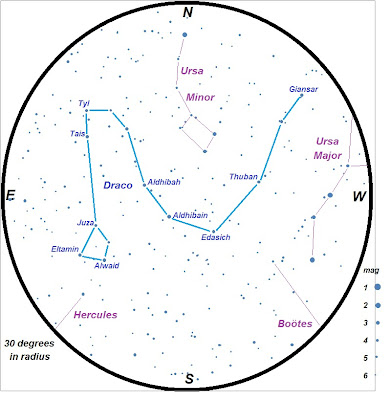

.....Draco is quite a large constellation, filling our starting placement map.  No zooming will be necessary.  One might note that while Draco has no truly bright stars, its has a number of named stars.  This seems strange at first blush, so let's conjecture why this might be...

.....First, when many of our constellations were being named (or at least getting the names that would stick), Draco contained the North Celestial Pole, with the entire sky appearing to rotate around Thuban the way that the sky now appears to rotate around Polaris.  This naturally made  Draco an important constellation, so its stars were more likely to receive names.  But ask yourself this question: Why did stars receive individual names in the first place?  Imagine yourself standing outside, looking up at the stars with at least one friend (unless you are actually doing this, in which case I salute you, and hope that your presumably mobile device has a dimming feature).  Pick a star.  Now, how would describe which star you had picked to your friend?  If your star was the brightest in a given area, you might describe it that way, and if it was not, there is an excellent chance that you used that bright star as part of your directions.  If we start with a set of named stars, then we can cut out a lot of the uncertainty right from the get-go: "It's that star right below Vega," you might say (if it happened to be that star).  Now, if you were looking a Draco, Draco is (a) very large, and (b) low on bright stars.  that could lead to a number of stars in Draco getting names, just to have a starting point telling one not terribly bright star from another.

.....Speaking of names, the name Draco is probably more recognizable as Harry Potter's classmate and frequent antagonist from the eponymous series.  Readers (as opposed to movie viewers) may have recognized a number of star and constellation names, mostly in the Black and Malfoy families.  (What, did an astronomer cut J. K. Rowling off on her way to the coffee shop one day?)  Here are the names used, and where in the sky they can be found: 

Andromeda Tonks, nee Black, the mother of Nymphadora Tonks:  Andromeda is a fall constellation, now visible on the eastern horizon once night has fully fallen.

Alphard Black :The son of Pollux Black and the uncle of Sirius Black
Arcturus Black, patron of Sirius Black:  Arcturus is the brightest star in the constellation of
Boötes. 
Bellatrix Lestrange, nee Black, major villain: Bellatrix is one of the bright stars that form the winter constellation of Orion.  Bellatrix (Latin for "female warrior") is the western shoulder of Orion.

Cassiopeia Black:  Cassiopeia is a circumpolar constellation for much of the northern hemisphere, most prominent in the fall sky, appearing as an "M" or a "W", depending on what side of the Mississippi River you're on .  (At least around here. :) )

Cygnus Black: Cygnus (aka the northern cross, containing the star Deneb) is a major summer constellation.

Pollux Black:  Pollux is a bright star in the winter constellation of Gemini.

Regulus Arcturus Black:  Regulus is the brightest star in the constellation of Leo.

Sirius Black:  Sirius is the brightest star as seen from Earth (fine, barring the Sun, for the pedants out there), and is located in the winter constellation of Canis Major.

Callidora, Cedrella, Charis, Dorea, Elladora, Hesper, Isla, Lucretia, Marius, Phineas:  These are not star names.  Ms. Rowling apparently had other ideas, or ran out of star names that she liked.  (Oh come on!  What about "Microscopium Black", or "Aldhibain Black"?  That's a missed opportunity right there!)

.....Draco also takes part in a giant summer man-versus-reptile showdown.  As intimated here, and more visible on the August star map, Hercules is stomping in Draco's head, back-to-back with Ophiuchus while Ophiuchus is wrestling with Serpens.  Thankfully, the constellations were derived thousands of years before the advent of Freudian analysis.

.....Also, wow, this sould have been much more timely if I had posted it a month ago...