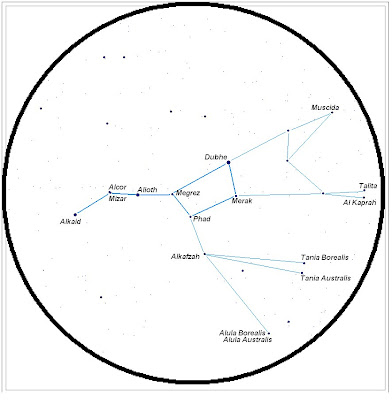
.....I have worked at this for some time, and I have now settled on a system of chart scales. (I had intended to let each chart be at what seemed like an appropriate size scale for that individual constellation, but the advantages of using a standard set of scaled views are pretty appealing. Some constellations, such as Draco or the combined Ophiuchus and Serpens, naturally fill a field of view thirty degrees in radius. (At arms length, both hands held together - or, as I now notice, your right hand and a friend's right hand - span thirty degrees in the sky.) For smaller constellations such as Lyra (shown below), the "Constellation View" shows the constellation in context with other constellations around them, which serves (I hope) to make them easier to find. On the "Constellation View" charts, the faintest stars are sixth magnitude, the theoretical lower limit of visibility for the average person with a dark, moonless, sky.

.....Smaller constellations should still get a view of the whole constellation, and larger constellations could be served by higher resolution views of interesting areas. These maps are "Binocular View" maps, making the implicit assumption that this closer view serves to let use find interesting areas, and search through them. For this reason, the faintest magnitude plotted on the chart is eighth magnitude - too faint for the unaided eye (although perhaps I shouldn't be trying to avoid getting Google hits for the word "naked" - a hit is a hit, after all), but visible in binoculars.

.....The final goal for this blog is to help the reader (especially the reader relatively new to observing, or observing through light pollution) find interesting telescopic objects. This brings us to "Finder View", with a radius of five degrees, and showing the amount of sky typically visible through a "standard" small telescope. These will usually be used to help the gentle reader find cool things to look at, and the faintest star going down to tenth magnitude, bright enough to be fairly easily seen through a small telescope.

.....The map above zooms in on one of the easiest to find deep-sky objects, the Ring Nebula (M57), a planetary nebula (the swelling former outer part of a star, dissolving into space). In a small telescope, this appears as a fuzzy bright doughnut of light.