Thursday, August 11, 2011

The Best Meteors of the Year ... Darn It!

.....The most reliable meteor shower of the year is the Perseid meteor shower, usually peaking on the night between August 11th and August 12th.  In younger years, this was the one time during the year that I could get the whole family as interested in astronomy as I was, a situation that I found was pretty common.  In recent years, I have often held public observing sessions, which have turned out really well, as there is no bottleneck at the telescopes; meteor observing is laying back, getting comfortable, and trying to keep as much of the sky as possible visible to see shooting stars.  Easy to set up, and enjoyed by all.

.....I'm not doing that this year.

.....Let me explain why.  Every dark, moonless night not dominated by city lights, we can expect to see a few shooting stars per hour, flashing randomly across the sky. These typically come from one of three sources: Leftover bits of flotsam and jetsam that have been floating around the solar system for the last five and a half billion years (cool), little bits that have been boiled off of comets as they passed around the Sun (also cool), or nuts/bolts/heat shields/tool boxes that have come off of space craft and are crashing back down to Earth (less cool).

.....Each time a comet passes through the inner solar system, if it still has much of its original ice, that ice will boil off, taking some dust pebbles with it, and the ice will reflect sunlight, resulting in the bright coma and tail. What happens to this once the comet goes back to the outer reaches of the solar system? Nothing. That comet rubble stays in orbit, resulting in the comet's orbit eventually becoming a dusty tube of gunk around the Sun. If the Earth should pass through this gunk, then when the particles hit the Earth's atmosphere they will light up from the heat of friction generated from going from a temperature of less than three hundred degrees below zero (Fahrenheit) to thousands of degrees. Since all of these meteors are coming from the same general area in space, they will appear to come from the same general area of the sky, meaning that the meteors will all seem to radiate out from the same point. (Called, reasonably enough, the "radiant".)
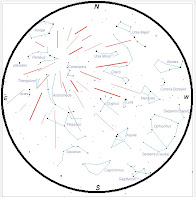
.....Each August, the Earth passes through the remnant trail of the comet Swift-Tuttle, generating the Perseid meteor shower because the radiant of the meteors (the dotted circle in the image below) is in the constellation of Perseus.  Meteor showers do not require a telescope or binoculars; just go outside and look (in this case to the northeast, especially after midnight).

.....A lot of this is part of the standard run up to a meteor shower.  What makes this year different is that the meteor shower peaks only about a day before the full Moon.  Looking at different sources, the number of meteors per hour for the Perseid Meteor shower is usually given as a number between 60 and 120.  (Wow!)  Now let's look at that as the sky gets brighter due to the Moon.  Even if we take the most generous version, that considers that we can see all the way down to our eyes limit.  With the bright Moon, we can't.  With an interfering Moon, even if we could see down to fifth magnitude (as opposed to sixth magnitude, our limit), we would go from 120 down to about 46.  The full Moon is much more limiting than this, however.  Even if we assume a third magnitude limit, we're down to about seven.  Per hour.  With any bad or humid air, this could limit us to second magnitude (maybe three meteors an hour, if we're lucky), or first (maybe three meteors every four hours).  This is enough of a enthusiasm-killer that it's better to look to next year, when the moon will be much less troublesome.
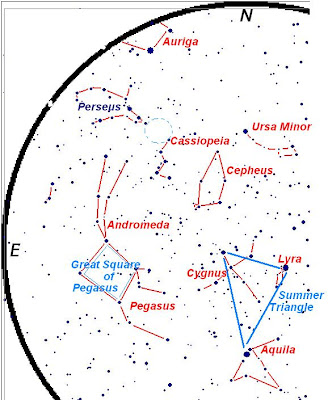
.....Looking for Perseids can still be done in the nights leading up to Thursday night, but the Moon will drown out most of them.  Here is a map of the northeastern part of the sky on Thursday at about midnight.

Monday, August 8, 2011

The Best Meteors of the Year ... Darn It!

.....The most reliable meteor shower of the year is the Perseid meteor shower, usually peaking on the night between August 11th and August 12th.  In younger years, this was the one time during the year that I could get the whole family as interested in astronomy as I was, a situation that I found was pretty common.  In recent years, I have often held public observing sessions, which have turned out really well, as there is no bottleneck at the telescopes; meteor observing is laying back, getting comfortable, and trying to keep as much of the sky as possible visible to see shooting stars.  Easy to set up, and enjoyed by all.


.....I'm not doing that this year.

.....Let me explain why.  Every dark, moonless night not dominated by city lights, we can expect to see a few shooting stars per hour, flashing randomly across the sky. These typically come from one of three sources: Leftover bits of flotsam and jetsam that have been floating around the solar system for the last five and a half billion years (cool), little bits that have been boiled off of comets as they passed around the Sun (also cool), or nuts/bolts/heat shields/tool boxes that have come off of space craft and are crashing back down to Earth (less cool).

.....Each time a comet passes through the inner solar system, if it still has much of its original ice, that ice will boil off, taking some dust pebbles with it, and the ice will reflect sunlight, resulting in the bright coma and tail. What happens to this once the comet goes back to the outer reaches of the solar system? Nothing. That comet rubble stays in orbit, resulting in the comet's orbit eventually becoming a dusty tube of gunk around the Sun. If the Earth should pass through this gunk, then when the particles hit the Earth's atmosphere they will light up from the heat of friction generated from going from a temperature of less than three hundred degrees below zero (Fahrenheit) to thousands of degrees. Since all of these meteors are coming from the same general area in space, they will appear to come from the same general area of the sky, meaning that the meteors will all seem to radiate out from the same point. (Called, reasonably enough, the "radiant".)

.....Each August, the Earth passes through the remnant trail of the comet Swift-Tuttle, generating the Perseid meteor shower because the radiant of the meteors (the dotted circle in the image below) is in the constellation of Perseus.  Meteor showers do not require a telescope or binoculars; just go outside and look (in this case to the northeast, especially after midnight).

.....A lot of this is part of the standard run up to a meteor shower.  What makes this year different is that the meteor shower peaks only about a day before the full Moon.  Looking at different sources, the number of meteors per hour for the Perseid Meteor shower is usually given as a number between 60 and 120.  (Wow!)  Now let's look at that as the sky gets brighter due to the Moon.  Even if we take the most generous version, that considers that we can see all the way down to our eyes limit.  With the bright Moon, we can't.  With an interfering Moon, even if we could see down to fifth magnitude (as opposed to sixth magnitude, our limit), we would go from 120 down to about 46.  The full Moon is much more limiting than this, however.  Even if we assume a third magnitude limit, we're down to about seven.  Per hour.  With any bad or humid air, this could limit us to second magnitude (maybe three meteors an hour, if we're lucky), or first (maybe three meteors every four hours).  This is enough of a enthusiasm-killer that it's better to look to next year, when the moon will be much less troublesome.


.....Looking for Perseids can still be done in the nights leading up to Thursday night, but the Moon will drown out most of them.  Here is a map of the northeastern part of the sky on Thursday at about midnight.

Thursday, July 28, 2011

Why I hate Microsoft's Spellchecker

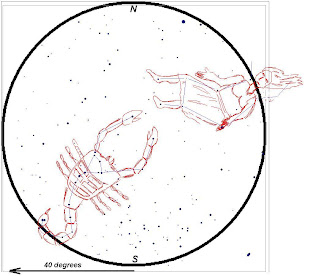
.....The constellation of Scorpius (the Scorpion) appears in the southern sky at this time each year, as seen from the Northern Hemisphere. There are several myth explaining this constellation; of them, one holds that this is the scorpion that killed Orion the Hunter, thus explaining why the two constellations can never be seen in the sky together. (There is more than one story concerning the death of Orion, so this may explain why Aesculapius is credited with bringing Orion back back from the dead to be killed in more interesting ways by the gods. I've had days that felt like that.) A different myth from Hawai'i explains that this constellation is Maui's fishhook, which got caught on the bottom of the ocean and dredged up the Hawaiian Islands.

.....There have some good news, and I have some bad news ... oh, what the heck, I'll start out with the good news, everybody likes good news ... Scorpius has a number of bright stars, and it's basic pattern (a scraggly line) is fairly easy to follow. Furthermore, as we will see on our next cycle through the constellations, Scorpius has a number of bright star clusters, and some of them look very attractive through binoculars. (Two bright open clusters can be found by looking just to the northeast (up and left, on the map) of Shaula and Girtab. these are labeled as M6 and M7, and they are quite nice sights in binoculars or a telescope. This is not a surprise, as the summer Milky Way goes through Scorpius and Sagittarius, and covers most of these constellations. In fact, on this map the center of our galaxy is about 30,00 light years away, in a direction just north of M6.

.....The map below shows Scorpius on our "standard" sized maps, with a radius of 30 degrees (where the angular distance across the sky from the end of a fully extended pinky to the end of a fully ectended thumb, held at arm's length, is about 15 degrees.

.....Let's zoom in a bit (the radius of this image is 20 degrees) so that the traditional star names clearly refer to their associated stars, and we get a bit of a closer view.


.....The bad news is that Scorpius is located far to the south in the sky. In the northern hemisphere, Scorpius spends less time above the horizon, rising in the southeast (instead of the east), and setting in the southwest. On the chart below, I am showing the approximate horizon for Scorpius, at its very highest, for a selection of American cities. (If you don't live in one of these cities, go by latitude.) For areas that correspond to the northern United States (Philadelphia is at about the same latitude as Beijing, and is actually south of Istanbul), Scorpius is only fully above the horizon for a brief time. Add to this that this map assumes an uncluttered southern horizon, so that any trees, hills, or Pump 'N Munches will interfere with that, and that when looking that low on the horizon you are looking through more than five times as much, wobbly, humid, dusty air as when you look straight up, observing Scorpius can feel like you are trying to do so from the bottom of a swimming pool.


.....So if you are living in the continental United States, or at comparative latitudes (in Asia, the horizon of Karachi, Pakistan would be roughly equivalent to Miami), then the existence of the stars in the highlighted area will simply have to be taken at my word.

.....Now if you have gotten your knowledge of the sky from a newspaper column across from Family Circus, or if you are a spellchecking program, you may have been subconsciously changing the name of the constellation to "Scorpio" but that's not its name. Spread the word, okay?

Thursday, July 21, 2011

Snakes! Why'd It Have To Be Snakes?

.....One of the largest constellations in the summer sky is actually two constellations. In another sense, it could be thought of three constellations. Technically, the constellation of Ophiuchus is the Serpent Bearer, and the constellation of Serpens, the serpent that he his carrying/wrestling with. Here is a map of the constellation:


.....And below is the representation of this constellation as Johann Bayer drew it in the star atlas Uranometria, in case my description of the constellation didn't make sense to you ...

When illustrating a figure named "man wrestling giant serpent" it is a wise artistic move NOT to show from the front.

.....which would be reasonable, as while most constellations at least make some sort of surface level of sense (the hunter, the scorpion, the northern crown, the swan, ...) what the heck is up with "the guy holding snake"? When does that make sense?


.....Here's where the problem comes in. Suppose that it is not a good night, and the limiting magnitude is 2.00. (This would be a really bad night in the country, but if you live somewhere with a lot of streetlights, this could come into play as a bright night or if that part of the sky is over some of these lights.) In that case, you see nothing in this area.


.....With a little better sky, and a limiting magnitude of 4.00, at least the "house" shape of Ophiuchus shows up. Serpens is largely invisible yet, and since there are no real patterns in Serpens, just a "scraggly line of stars", this constellation is still invisible. (On our next pass through the constellations, next year, this does at least give us bright stars to allow us to start finding all of the bright globular clusters in these two constellations.)


.....We need to be able to see all the way down to fifth magnitude in order to make out the patterns of Ophiuchus and Serpens. On the map at the beginning, for this constellation I had to show stars down to sixth magnitude in order for the patterns to be apparent.


.....All of this can distract from the basic oddness of the constellations themselves. I'm not referring to Serpens being split in half, with Serpens Caput (the head) and Serpens Cauda (the tail), but the story of the constellation itself. The constellation group seems to be so old that there is not "a" story associated with the stars, but a "well, I guess it means..." explaining the large pattern of a guy wrestling with a snake. The most common explanation is that the star group represents Aesculapius, the son of Apollo who became so proficient at medicine that he could bring the dead back to life. (One of his subjects was Orion the Hunter, or this could be a Classical retconn to account for the two different legends of Orion's death.) This, as one might guess, is one of the fast ways to land you on the gods' &^%$ list, so he was immediately struck down and placed in the heavens. The serpent has represented the medical profession (including the intertwined serpents of the Caduceus) because the ancients saw the snake shedding its skin and got the idea that the snake could therefore regenerate its way to immortality, a feat actually reserved for Timelords. There are many, many other myths that have been attached to these stars from " Hey, maybe it's Izhdubar opposing Tiamat" to "Hey, let's change it to Saint Benedict among the thorns".

.....I was going to now try and see if I could find some other pattern among the stars that might be more recognizable than, well, something that no one has recognized, when Anne Marie walked behind me and asked, "Which constellation is the frog?"

.....Frog? What the heck are you talking ...


.....Well, blast.

.....Lastly Ophiuchus is actually the thirteenth constellation of the Zodiac, as the path of the Sun crosses that little leg sticking out of the bottom. Ophiuchus actually contains the Sun from November 30th until December 17th. Scorpius only contains the Sun from November 22nd until November 29th. (Yes, neither of these match up with what the columns in the newspapers say: those are based entirely on the Babylonian religion of 2500 years ago, and have slightly less reliability than, say, Charlie Sheen.

Tuesday, July 12, 2011

The July Sky

.....The was a bit of a blip posting this, so here is the correct version.

.....Below is shown an image of the night sky as it is at ten PM in early July (corresponding to nine PM in mid-July, and eight PM by late July.  We can now start to see how the sky changes over time by comparing the sky in July with the sky in June (also shown below).


.....As before, I have included constellations that have already been discussed (Boötes, Ursa Major, Libra, Ursa Minor, and the asterism of the Summer Triangle) as well as some constellations that will be coming soon, such as Ophuichus and Serpens, Scorpius, Sagittarius, Lyra, Aquila, and Cygnus).  Note that on the maps below, the points of the compass are shown as on the maps above.  To see these constellations, take your computer (or print out the map, totally your choice) and turn it so that the labeled north (south, east, west, whatever) is at the bottom of the map when you are looking north (south, east, west, whatever.

.....The summer sky can illustrate a couple of different points.  The map below shows all stars theoretically visible, all the way down to sixth magnitude.  There are two reasons why I don't use this map for my basic sky map; sadly, the vast majority of people don't get to see the sky like this (I did, last week, and I'll be writing about that tomorrow), and if you did see the sky like this, it might well overwhelm even a fairly experienced suburban skywatcher.  Also on the map below, you might note that there are more stars in the eastern sky than the western sky, and that there almost seems to be a band going from the south to the northeast.  This is the summer Milky Way with the center of our galaxy between Scorpius and Sagittarius (and then another 30,000 light years), so hopefully this makes sense.


.....This map assumes that the reader can see stars of fifth magnitude or brighter.  This is still wildly optimistic for most people, but as you will see, I kind of need to go to this level in order for the patterns as generally associated with the constellations to make any sense.


 .....This map shows the sky to a limiting magnitude of fourth magnitude (remember that the lower the number, the brighter the star).  Holes start to appear in the constellation patterns.


 .....If the sky is cloudy or bright enough that nothing fainter than third magnitude can be seen, then only the larger patterns (such as the Summer Triangle) can be seen.


 .....Now that only second magnitude stars or brighter are shown, then only the brightest stars appear, but it is still enough to allow you to orient yourself.


.....If first magnitude stars are visible, one might wish to go back inside and expand your mind or hang out with loved ones, or, at this point, just watch some TV.


.....Finally, it could be completely cloudy:

Thursday, June 23, 2011

Libra (Reprsie)

.....Libra is the first of the constellations along the Zodiac that I have written about here. What is the Zodiac? The ecliptic is the path that the Sun takes through the sky, and the planets all stay within 7° of this line (If we skip Mercury, all the planets are within half this distance of the ecliptic). The ecliptic passes through twelve constellations (traditionally; as the constellations were given boundaries by the International Astronomical Union in 1930 the ecliptic passes through thirteen constellations), and these constellations are the Zodiac. Besides being the only zodiacal constellation with no bright deep sky objects, Libra is also the only zodiacal constellation named after an inanimate object.

.....Our constellations can be traced back to the forty-eight the Greeks had (there are eighty-eight constellations now), but the constellations of the Zodiac are much older. This makes sense because while many of the constellations can be thought of as “sky-decorations” the Zodiac allowed the ancients to track the seasons. Of the zodiacal constellations, Libra might one of the youngest.
.....Libra as the balance represents that the Sun would be in this sign at the Autumnal Equinox, when the day and night would be equal lengths, or at least it was. According to the boundaries as they are now, the Sun would be in Libra at the equinox from about 2200 BC until about 700 BC. Close to this time, if Libra did not exist as a constellation of its own, then it could have been created, to allow for twelve (one per month) constellations around the zodiac. I imagine (spoken in some Indo-Aryan root), "Okay, we need a new constellation for this point where the day and night are the same length. Remember, everything else on this list is a living thing, hence the 'zoo' in 'zodiac'." Six hours of debate follows, in which Chester (or the Indo-Aryan root for "Chester") rejects a bunch of things because they're "stupid, ten more things are dropped because Bert is allergic to shellfish, the "Claws of the Scorpion" is out because Bob of the High-Pitched Voice sat on one once, and then, "&#@% it, we'll call it the "scales", happy hour is almost over. (The bartender gave the lizard an extra squeeze, or something. Heck, I don't know what ancient beer was like.) Geez, this could have been the first "designed by committee" in history.

.....Even when not using the strict modern boundaries, the wobble of the Earth around its axis (which I discussed in a post on Ursa Minor) would have carried the equinox into Virgo, where it is now (and where it will be until AD 2450). This seems to indicate that Libra as a scales must have existed when the equinox was well inside Libra, but there are many references to these stars as Chelae, the claws of the scorpion. First, as seen below, the stars of Libra work well as the claws of the scorpion, whereas with Libra as a scales, the scorpion’s claws seem a little pathetic. The (seriously cool) names of the stars could refer to this, with Zubeleschamale translating as “the northern claw” and Zubelelgenubi as “the southern claw”. This is contested in some sources (alright, I admit it – in an unsourced article on Wikipedia) in that the Arabic (zubānā) and Akkadian (zibanitu) words for “scorpion” and “scale” are the same. Life becomes more complicated with the constellation having either four claws or four scales, but Richard Allen’s Star Names: Their Lore and Meaning considers Zubelalgubi as a degenerate version of the name “Zubelelgenubi”, and Zubenelhakrabi (the scorpion’s claw) as belonging to g Scorpii, which was apparently due to a need to invent two new claws when the other ones became Libra.
.....Why were the scorpion’s claws made into the balance of Libra (assuming, of course, that this is what happened)? Sure, there would be pressure to have twelve constellations on the Zodiac, one per month, and the reason of having a balance at the point where day and night are balanced make sense, but I have another idea why an inanimate object was added to the Zodiac where it was …
Five minutes before the first sexual harassment lawsuit
.....Zubenelgenubi is a fairly easy double star to split, with the companion star being dimmer, but not tremendously dimmer (magnitudes of 2.8 and 5.2), and about 4 minutes of arc apart, or about one-eighth the size of the Moon in the sky. I could split this double star with a pair of binoculars, so this represents an excellent opportunity to do the same, and take the first step towards learning how to observe and split double stars.

Tuesday, June 21, 2011

The Summer Solstice

.....(First, I hope that this is not causing anyone to skip my post on viewing Mercury, posted yesterday.) Here's what set me off.  I was directed to a story on the solsticeFirst I'll give you a post on why this is the summer solstice for the northern hemisphere, and try and keep from going off on the problems I saw in the "news" story.  If you are at a cookout, the closer you are to the fire, the warmer you are.  If you are getting an English muffin out of the toaster, the closer you are to the toaster, the warmer your hand is.  In that case, it seems intuitive that the Earth is warmer when we are closer to the Sun.  It seems intuitive, but it is completely, totally, and utterly wrong.

.....The Sun does not move around the Earth (something that is only moderately difficult to get students to accept), but it looks like it does, in the same way that the sky can be treated as a big imaginary sphere.  As the Earth rotates, the North Celestial Pole (NCP) is the point in the sky that appears directly above the Earth's north pole, and the South Celestial Pole and Celestial Equator are ... I hope that you get the idea.  Since the NCP is directly overhead at the north pole, or 90° above the horizon, and the NCP is on the horizon, or at an angle of above the horizon, we can see that the angular height of the NCP is the same as our latitude.  We can then track the apparent path of the Sun across the sky as the ecliptic.  Why we have seasons comes from the fact (a fact that does not depend on whether USA Today says that it is true or not) that the Earth does not rotate with its equator in the same plane in which it is orbiting, but is tilted by 23.5°.  This means that the ecliptic is tilted by 23.5° to the celestial equator (the Earth's equator projected into space) as shown.  The Earth keeps this tilt constant as it orbits, the star Polaris always above the Earth's North Pole, as shown below.  (Not to scale.)


.....The effect of this is that during part of the year, the northern hemisphere is "leaning into" the Sun, and during part of the year, the northern hemisphere is "leaning away" from the Sun.  Imagine that we pick a point on the Earth, and then trace the path that it takes over one day, a circle inscribed across the Earth at your latitude.  The effect that this has on the day comes from two things.  First, notice that the point, at the northern hemisphere summer solstice, spend the majority of its time on the sunlit side of the Earth.  It is hotter in the summer partly because the Sun is above the horizon for a longer period of time.  The northern hemisphere has its longest time of daylight on the summer solstice because the tilt of the Earth points the northern hemisphere most directly towards the Sun on this day. 

 .....The second reason why summer is hotter has to do with the height of the Sun in the sky.  In summer, a quick glance at the diagrams above should show that the Sun is much higher in the sky in the summer, as opposed to the winter.  The Sun provides the same amount of energy to the Earth at all times, but if the Sun is low in the sky that same energy is spread over a greater area, having a lesser effect.  To take Winona, Minnesota, (with a latitude of 44°) as an example, the North Star is 44° above the northern horizon, which means that the celestial equator is (90°-44°=) 46° above the southern horizon.  On the summer solstice, the Sun is  above the celestial equator, or a maximum value of 69.5° above the horizon, as opposed to the winter solstice, when the Sun is only 22.5° above the horizon, at best.  These two effects combine to make summer hotter, and, as the observant may have noticed, at all times (not just on the summer solstice), the seasons in the northern hemisphere are the exact opposite as seasons in the southern hemisphere.

.....The Earth is actually closest to the Sun in January.  This might seem strange, but really, the Earth's orbit is so close to being a perfect circle that this difference is not detectable.  One might expect the Southern Hemisphere's summer to be slightly hotter than the Northern Hemisphere's Summer, but the Southern Hemisphere is mostly water, and water has a strong moderating influence on temperature changes.