Showing posts with label Scorpius. Show all posts

Thursday, July 28, 2011

Why I hate Microsoft's Spellchecker

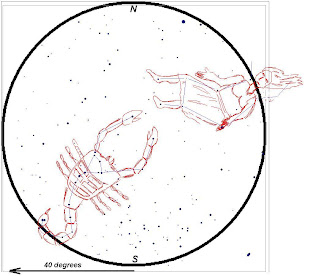
.....The constellation of Scorpius (the Scorpion) appears in the southern sky at this time each year, as seen from the Northern Hemisphere. There are several myth explaining this constellation; of them, one holds that this is the scorpion that killed Orion the Hunter, thus explaining why the two constellations can never be seen in the sky together. (There is more than one story concerning the death of Orion, so this may explain why Aesculapius is credited with bringing Orion back back from the dead to be killed in more interesting ways by the gods. I've had days that felt like that.) A different myth from Hawai'i explains that this constellation is Maui's fishhook, which got caught on the bottom of the ocean and dredged up the Hawaiian Islands.

.....There have some good news, and I have some bad news ... oh, what the heck, I'll start out with the good news, everybody likes good news ... Scorpius has a number of bright stars, and it's basic pattern (a scraggly line) is fairly easy to follow. Furthermore, as we will see on our next cycle through the constellations, Scorpius has a number of bright star clusters, and some of them look very attractive through binoculars. (Two bright open clusters can be found by looking just to the northeast (up and left, on the map) of Shaula and Girtab. these are labeled as M6 and M7, and they are quite nice sights in binoculars or a telescope. This is not a surprise, as the summer Milky Way goes through Scorpius and Sagittarius, and covers most of these constellations. In fact, on this map the center of our galaxy is about 30,00 light years away, in a direction just north of M6.

.....The map below shows Scorpius on our "standard" sized maps, with a radius of 30 degrees (where the angular distance across the sky from the end of a fully extended pinky to the end of a fully ectended thumb, held at arm's length, is about 15 degrees.

.....Let's zoom in a bit (the radius of this image is 20 degrees) so that the traditional star names clearly refer to their associated stars, and we get a bit of a closer view.


.....The bad news is that Scorpius is located far to the south in the sky. In the northern hemisphere, Scorpius spends less time above the horizon, rising in the southeast (instead of the east), and setting in the southwest. On the chart below, I am showing the approximate horizon for Scorpius, at its very highest, for a selection of American cities. (If you don't live in one of these cities, go by latitude.) For areas that correspond to the northern United States (Philadelphia is at about the same latitude as Beijing, and is actually south of Istanbul), Scorpius is only fully above the horizon for a brief time. Add to this that this map assumes an uncluttered southern horizon, so that any trees, hills, or Pump 'N Munches will interfere with that, and that when looking that low on the horizon you are looking through more than five times as much, wobbly, humid, dusty air as when you look straight up, observing Scorpius can feel like you are trying to do so from the bottom of a swimming pool.


.....So if you are living in the continental United States, or at comparative latitudes (in Asia, the horizon of Karachi, Pakistan would be roughly equivalent to Miami), then the existence of the stars in the highlighted area will simply have to be taken at my word.

.....Now if you have gotten your knowledge of the sky from a newspaper column across from Family Circus, or if you are a spellchecking program, you may have been subconsciously changing the name of the constellation to "Scorpio" but that's not its name. Spread the word, okay?

Friday, May 28, 2010

Libra: the Balance or the Scorpion Blocker

.....Libra is the first of the constellations along the Zodiac that I have written about here. (A curious reader might look at the current star map and wonder why I didn’t start with Virgo, much higher in the sky right now; the reason is that I am not just working my way around the sky, but that on this first pass I’m centering on the brightest of deep-sky objects, things that can be seen with a small telescope. Of the various types of deep-sky objects, the hardest to view are galaxies, and Virgo is so chock full of them that I am saving this constellation for last.)

.....What is the Zodiac? Well, the ecliptic is the path that the Sun takes through the sky, and the planets all stay within 7° of this line (If we skip Mercury, all the planets are within half this distance of the ecliptic). The ecliptic passes through twelve constellations (traditionally; as the constellations were given boundaries by the International Astronomical Union in 1930 the ecliptic passes through thirteen constellations), and these constellations are the Zodiac. Besides being the only zodiacal constellation with no Messier objects, Libra is also the only zodiacal constellation named after an inanimate object.
.....Our constellations can be traced back to the forty-eight the Greeks had (there are eighty-eight constellations now), but the constellations of the Zodiac are much older. This makes sense because while many of the constellations can be thought of as “sky-decorations” the Zodiac allowed the ancients to track the seasons. Of the zodiacal constellations, Libra might one of the youngest.

.....Libra as the balance represents that the Sun would be in this sign at the Autumnal Equinox, when the day and night would be equal lengths, or at least it was. According to the boundaries as they are now, the Sun would be in Libra at the equinox from about 2200 BC until about 700 BC. Even when not using the strict modern boundaries, the wobble of the Earth around its axis (which I discussed in a post on Ursa Minor) would have carried the equinox into Virgo, where it is now (and where it will be until AD 2450). This seems to indicate that Libra as a scales must have existed when the equinox was well inside Libra, but there are many references to these stars as Chelae, the claws of the scorpion. First, as seen below, the stars of Libra work well as the claws of the scorpion, whereas with Libra as a scales, the scorpion’s claws seem a little pathetic. The (seriously cool) names of the stars could refer to this, with Zubeleschamale translating as “the northern claw” and Zubelelgenubi as “the southern claw”. This is contested in some sources (alright, I admit it – in an unsourced article on Wikipedia) in that the Arabic (zubānā) and Akkadian (zibanitu) words for “scorpion” and “scale” are the same. Life becomes more complicated with the constellation having either four claws or four scales, but Richard Allen’s Star Names: Their Lore and Meaning considers Zubelalgubi as a degenerate version of the name “Zubelelgenubi”, and Zubenelhakrabi (the scorpion’s claw) as belonging to g Scorpii, which was apparently due to a need to invent two new claws when the other ones became Libra.
.....Why were the scorpion’s claws made into the balance of Libra (assuming, of course, that this is what happened)? Sure, there would be pressure to have twelve constellations on the Zodiac, one per month, and the reason of having a balance at the point where day and night are balanced make sense, but I have another idea why an inanimate object was added to the Zodiac where it was …
Five minutes before the first sexual harassment lawsuit
.....Unfortunately, Libra is pretty boring as far as deep-sky objects are concerned. There are no open clusters or nebulae in Libra, and the galaxies and one globular cluster in Libra fall far from being easy to find. I’ll address these on my next pass. Zubenelgenubi is a fairly easy double star to split, with the companion star being dimmer, but not tremendously dimmer (magnitudes of 2.8 and 5.2), and about 4 minutes of arc apart, or about one-eighth the size of the Moon in the sky. I could split this double star with a pair of binoculars, so this represents an excellent opportunity to do the same, and take the first step towards learning how to observe and split double stars.