Monday, June 20, 2011

High Mercury

.....I'm not referring to the temperatures getting hotter as we approach the Summer Solstice, but the planet Mercury, which is becoming visible in the west after sunset, although I might be overstating that just a bit. Of the visible planets, Jupiter and Saturn are easy to find. Saturn is still bright in the southern sky as it gets dark, and Jupiter is bright in the sky before dawn (slowly moving into the evening sky; by September, Jupiter will be replacing Saturn in the evening). Mars is basically visible every other year, since it is only a bit farther away from the Sun as the Earth, so when the Earth passes Mars, it takes a long time to "lap" it again. Venus, like Mercury, is either a morning star or an evening star, but it is much easier to see (explanation to follow).

.....Mercury (and Venus) orbits the Sun on a smaller orbit than the Earth has. This means that Mercury (for example) can never be high in the sky at midnight because it would then have to be exactly opposite the Sun in the sky. This is clearly impossible. Taking this to a less extreme case, we can see that Mercury will always need to be close to the Sun in the sky. (Mercury also has a very elliptical orbit as well - the most elliptical orbit by far of the official planets.)

.....As you can see from the above view, Mercury is never more than 28° from the Sun in the sky at the best of times, which makes viewing Mercury very difficult. (for the nest few weeks, we are at about the middle between these two extremes.) The Sun is so bright that nothing but the Moon can be seen in the sky with the Sun, so to see a planet, we need the Sun to be below the horizon. That means that Mercury can never1 be seen higher than 28° above the horizon, but it gets worse ...

.....The sky does not suddenly go dark when the Sun goes below the horizon because the light from the Sun is scattered in the atmosphere, so we have to wait longer, for the sky to darken, in order for Mercury to be visible. Astronomical twilight lasts until the Sun is 18° below the horizon, so in the best of times Mercury is only 10° above the horizon, while if Mercury is observed at its closest to the Sun, then Mercury will be setting at dark. Even in this best case, this means that we will be looking at Mercury through a heck of a lot more air. (We don't have to wait for the sky to be completely dark; Mercury is bright enough to show up while there still is some light in the sky, but it can be challenging to see.


.....When looking at an object 10° above the horizon, we are looking through 5.6 times as much air as when something is directly overhead. This would be like setting up your telescope at the bottom of a swimming pool - and it keeps getting worse.

.....The ecliptic is the path of the Sun across the sky. The planets have to stay near (though not on) this line, so at times when this line makes the greatest angle with the horizon (for the Northern hemisphere, this would be March), we have a better chance to see the planet. In June and early July, we are closer to the condition on the right above, than the left.


.....Until the first spacecraft went to Mercury (Mariner 10, in 1972-73), or the second (MESSENGER, in orbit as of this last March), views of Mercury were difficult to get. We had these really bad views, or wait for a solar eclipse (you guys check the footnotes, right?), so the best diagrams looked like those below, a sketch made by the astronomer Giovanni Schiaperelli. This does not look like satellite photos of Mercury (unavailable until 1973, and shown at the right). The sketch below looks more like a captcha than a planet!

Jello?

.....To see Mercury in the next few weeks look close to the horizon just after sunset. For example, tomorrow night, Mercury should appear at about 8:55 when it is about 7° above the horizon. This is less than the angle between your fingers when making the Arachnid Super Hero gesture / secret devil sign (depending on your taste in seventies metal) at arms length. You can see that if you have a wooded or hilly horizon, you are kind of hosed. The best case scenario will be on July second starting at about 9:05 when Mercury will be 10° above the horizon. Woo hoo!

1: Or during a solar eclipse, but that seems like an uncommon an extreme caveat to toss in.

Wednesday, June 15, 2011

Getting Mooned

....All photos in this post were taken by the author using a Canon PowerShot A630, sometimes through an 8" Celestron Schmidt-Cassegrain telescope.  The camera is held up to the telescope by an Orion SteadyPix Deluxe. 

.....If you have been outside in the evenings, you will have noticed that the Moon is getting bigger and brighter each night, heading to a full Moon tomorrow.  I have to confess that I've been (perhaps unfairly) biased against the Moon.  From the time that I started getting interested in astronomy, I have been searching in the sky for new objects that I haven't seen before, trying to find the faintest thing that I could find.  The Moon was therefore my enemy.


.....Furthermore, I could never find the "Man in the Moon".  Do you see it below?  I don't.


.....I do, however, see the rabbit.  The idea of the rabbit in the moon appears in a number of Asian legends, but I think that I'm remembering a story where the rabbit is thrown there.  Watership Down? Anyway, if you don't see it, here it is:


.....Zooming in:


.....See?  The rabbit even has a carrot.  This hatred of the Moon eased when my wife got me an attachment for my telescope allowing the camera to stay still long enough to take images through the telescope.  Here is a image of the waxing crescent Moon.


.....Photography actually is helping me enjoy observing the Moon.  One of my problems has been that it has been hard for me to adjust to most of the available maps of the Moon.  Why this is, I'm not sure.  Telescopes will invert the images as we see them. (In most cases, who cares, as there is no "up" in space - except on the Moon.)  Antonin Rükl's Atlas of the Moon was much easier to use for me (it seems that there is a revised edition - I wonder what changed), so I was able to map images to place names.  This means thta I can learn more about specific places, and then go back later and find them again!  Let's start with some of the Maria (singular: Mare), dark areas on the Moon produced from three to three and a half billion years ago when massive impactors hit the Moon hard enough to break through the surface and cause some of the still-molten interior of the Moon to boil up and re-surface the area.  Maria typically have few craters, since they were formed after most big things that were going to hit other big things already had.  (It is not a thing that could be done twice, after all.)  These features are named as if they were bodies of water because they appeared flat and featureless to early telescopic observers.

.....Let's start by looking at some of the Maria best visible during the first half of the month, and as the blog goes on, I will return to the Moon when I can to look at more features, and learn more about the ones we can identify.  The photo below has labeled areas including Mare Humboldtianum (Humboldt's Sea, named after an explorer because it lies on the border of the part of the Moon that we can see, and the part of the Moon that we can't see, always on the edge of the unknown), Mare Crisium (The Sea of Crisis), Mare Frigoris (The Sea of Cold), Lacus Somniorum (The Lake of Dreams), Mare Tranquitalis (The Sea of Tranquility), Mare Fecunditatis (the Sea of Fertility), and Mare Serenitatis (the Sea of Serenity)


.....For instance, that footprint, Mare Undorum (the Sea of Waves) and Mare Spumans (the Foaming Sea) - what's up with that?


Monday, June 6, 2011

The Arietid Meteor Shower

.....Rather unfortunately, tomorrow morning the Arietid meteor shower will be at its peak. Wow! I'm only one sentence in and I already have to explain at least four things ...

.....Meteors, or shooting stars, are small (hopefully!) particles that hit the Earth's atmosphere. Since the Earth is moving through space at about thirty kilometers every second, and the particle is going to be moving bout the same speed, the friction of the air will heat the object to glowing hot as it dissolves. Those flashing lights can come from several sources. Some of them are the flotsam and jetsam of the solar system, little pieces of leftover rock that have been floating around from the beginning of the solar system. Some have actually been blasted off of other planetary bodies, like the Moon, Mars, or asteroids - even asteroids that have been shattered in impacts in the distant past of the solar system. This is compelling stuff, but it is unfortunately not what we are talking about here. Some of these meteors can be seen each night, usually on the order of a half-dozen or so, if you're lucky. (Source)

....Meteors can also be heat tiles, nuts, bolts, tool bags, etc. After fifty years of space travel, a rather astounding amount of space junk has built up in the space around the Earth, to the point where this junk is a positive threat to space travel and new satellites that has to constantly be taken into account. (I had lived for four years in central Florida when I had cause to remember that any object launched into orbit will adopt an orbit that carried it over its original launch point periodically. How disappointing it was to have four years of meteor watching cheapened by realizing that some large fraction of what I had seen was "just" junk!)

.....Meteors can also come from comets. Consider a bright comet, passing through the inner solar system:

.....We see a comet by looking at the bright tail. We see the bright tail because the tail is made of many particles of ice and ice-covered dust released from the comet during eruptions caused by heating from the Sun. These eruptions also release a lot of dust and rocky particles from the comet, and those bits and pieces don't simply disappear when the comet (now the comet et al), moves far enough away from the Sun for the nucleus to quiet down. (We're not allowed to have something simply appear or disappear without a way to explain where it came from or where it went.) The bits that are blasted off stay in the same orbit, although they do spread out through the orbit over time. these ex-comet parts are what give rise to meteor showers.

.....Comets rarely (dramatic understatement) impact the Earth. Even when their orbits cross the Earth's orbit, the chances of the Earth and the comet both being there at the same time are remarkably tiny. However, if the comet has passed by the Sun enough that there is a great deal of debris spread throughout the orbit, the Earth can hit this. Each of these small particles becomes a meteor, and since the meteors are all coming from the same stream, and thus approaching the Earth along the comet's orbit, all these meteors appear to be coming from the same spot in the sky. (The spot where the comet's incoming orbit hits an imaginary shell representing the sky around the Earth.) This spot in the sky is called the radiant of the meteor shower, the point that meteors in this shower appear to radiate away from, and the point for this shower is in the constellation Aries. Hence, this meteor shower is refered to as the Arietid Meteor Shower. (The map is good for 4 AM tomorrow morning.)
.....I said "unfortunately" at the beginning of this post because the above star map, showing the location of the Arietid radiant, shows the sky shortly before dawn. This means that the Arietid shower is a daytime shower, and there are darn few meteors bright enough to be seen during the day. Sure, there is a chance to see meteors in the couple of hours before dawn ...

..... The typical number of meteors per hour for the peak of the Arietid meteor shower is about fifty per hour, but that is misleading. You might (on average) see fifty meteors an hour if your sky was completely without light pollution, and the radiant was directly overhead, but we aren't going to get that. A perhaps sizeable fraction of you paused at my words "before dawn" earlier. Yep, when I suggest that something cool is going to be visible in the sky, nothing kills the joy faster than the words "before dawn". At this point, I might even have negative readers for the rest of this paragraph ...

....So if you aren't willing to get up before dawn (statistically speaking, you aren't) is there any way to detect meteors during the day? As it turns out ...

.....Meteors heat up, glow, and (mostly) dissolve in the upper atmosphere. Along their paths, they leave ionized gases, knocking electrons briefly free, and this can reflect radio waves moving through the atmosphere, causing you to briefly hear radio stations more than a thousand miles away. If tomorrow morning the radio briefly cuts out, or if some station you don't recognize surges for a few seconds, that might be due to the path of a meteor.

.....Or, if you want to try to see some of these, look to the east before dawn. One advantage of these types of meteor showers is that the meteors will move comparatively slowly. This is an advantage if you, like me, tend to be able to summon fast-moving meteors simply by looking down.

Monday, May 23, 2011

The Brightnesses of Stars

.....One of the biggest problems with just getting into astronomy is learning a new language , made all the more confusing because it looks so much like English. There are a lot of terms which, don't worry, become familiar very quickly, but if you just pulled an astronomy book or magazine off the shelf in a bookstore, can seem to make little sense. I'm going to try to avoid new terms (just for the sake of new terms) where I can, and where I think it's important, I'll call special attention to them, like now.

.....It is hard to start off a column with an apology for two thousand years of common use (so I waited until the second paragraph! woo hoo!), but there is a habit that started with a Greek astronomer about 2300 years ago. This astronomer, Hipparchos, divided the stars in six categories with the brightest stars as "stars of the first rank" and the dimmest stars as "stars of the sixth rank". This seems to make sense until we track this this forward into the nineteenth century, and people are able to take photographs of stars and make absolute measurements of the amount of light coming from a particular star, as opposed to simply "brighter than that other star over there", when astronomers decided to keep the magnitude system.

.....This means that a star with a magnitude of 6.00 is the faintest star that can be seen with the naked eye (I normally use "unaided", but I want this blog to show up under Google searches for 'naked'; heck - naked naked naked) and a star with a magnitude of 1.00 is quite bright. The Sun has an apparent magnitude of -28. This can be hard to track. Still, at this level, we can still use the magnitude system in a reasonable way.

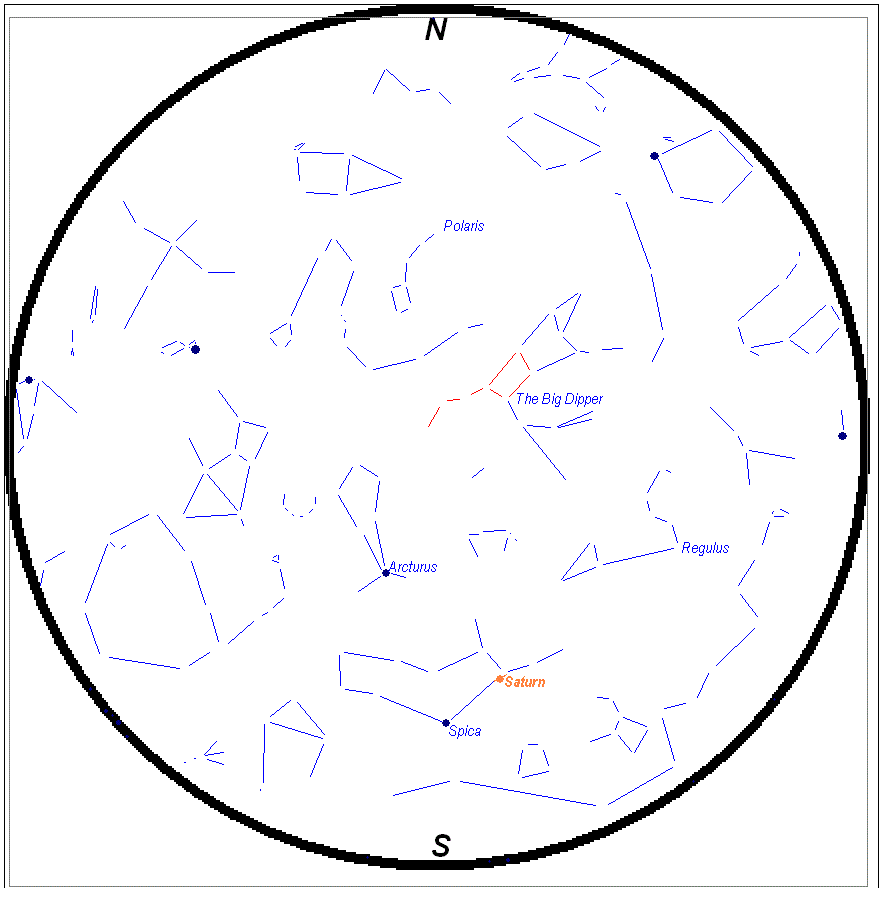
.....Consider this map below, which is the June 2011 sky as it might appear in a magazine such as Astronomy or Sky & Telescope, which shows stars down to fifth magnitude (going all the way to sixth magnitude would add about 1,600 tiny dots to the map; not a great deal of use is added.
.....(I chose to only include stars and asterisms that have come up in the blog. Since this blog is fairly young, that's not a lot.) Even if I had put all the names on the map, consider looking up at a sky like this:

.....If you are just starting out, this can be pretty darned intimidating, plus, unless you live someplace away from cities/car dealerships/McDonald's. I certainly can't walk out my back door and see fifth magnitude stars! We can speak of how many stars we can see by talking about a "limiting magnitude". A reasonably dark, moonless suburb, with no direct lines of sight to street lights, might have a sky with a limiting magnitude of fourth magnitude:

.....As you can see, even with a limiting magnitude of four, "holes" are appearing in the patterns. Move a little bit closer to town (or let the gibbous Moon rise), and we have a limiting magnitude of three:

.....That last one is about what the sky looks like from my back window on a good night. You'll notice lots of holes in constellation patterns; some entire constellations have vanished. At this point, the lack of stars (which might have seemed beneficial to a beginner who did not want to be overwhelmed) now works against us. This is why I started with the Big Dipper and a few bright stars. After all, toss in some thin clouds and we go to second magnitude. (Notice that when we are looking at this map there are a few sets of bright stars. The three bright stars rising in the east we will come back to, in time.)


.....And on a very bad night, if all that we can see are stars of first magnitude or brighter, the sky is fairly empty.


.....Drat. I just noticed that I did not add Saturn to the empty star maps.

Thursday, May 19, 2011

Rings Around the May Sky

.....I love looking at the stars, and I, like a lot of other people, want to help other people recognize what is there to be seen, but if you look at a star map in a magazine like Astronomy or Sky & Telescope, or at a useful web site such as Heavens Above, you will get a skyful of constellations, but you might not have the experience or confidence to use all this. As we go through the sky constellation by constellation, I will add these into the mix.

.....So far, we have only covered the Big Dipper and the bright stars that we can find with the Big Dipper ... plus one. We start with the Big Dipper and stars as it is seen at 10 PM on May first (which is, admittedly, well past). At the beginning of each month, I will post a view of the night sky at 10 PM. Will this be uniformly useful? Often not. In the summer, it might not even be dark at ten, and in the winter it will have been dark for several hours, but this will still be helpful if you observe within a few hours of 10 PM. The map is also set up to show the sky from 44 degrees north, pretty close for most of the northern United States and well set up for Europe, but a viewer in the southern US or Japan would only notice a slight shift in the positions of the stars. SO let's take a look ...

.....Added to this set of stars is the one bright planet visible in the evening sky, Saturn. (Sorry, SATURN!!) If you ave a telescope of even the smallest size gathering dust in a closet, you should definitely get that out, because Saturn is one of the few things in the sky that actually looks like it's supposed to. As I go through the sky, there will be a lot of deep sky objects that can be found in a telescope that (I know from bitter experience) get a response of, "So, is that it? The little fuzzy bit?" Saturn, in a telescope looks like *&^%&^* Saturn. Saturn's rings are clearly visible in even the smallest telescope, and you will definitely know that you have found them. On a good night, the Cassini division, the dark line between the two rings is visible, and Titan - the largest moon of Titan, and the only moon with an atmosphere (but it's still no Yavin IV).

Thursday, February 17, 2011

The Northern Lights - maybe tonight!

.....On Monday, the Sun released a tremendous amount of material and energy in the general direction of Earth, and that material is now encoutering the Earth.  The tremendous burst of charged particles, when they interact with the Earth's magnetic field, get forced to follow the field lines until all the particles are spun into a tightening flow as the magnetic field lines get closer as they bend to Earth near the north and south magnetic poles.  What happens then is the same as what happens in the flourescent bulbs in your office.  The fast-moving charges energize the electrons around the gases they are passing through, leading to a glow in the sky, the northern lights.  If you have the opportunity to go outside and look north tonight, take the chance and look towards magnetic north. Maybe you'll see (as I used to, in the Upper Penninsula of Michigan) a greenish semicircle of light around magnetic north ... or maybe something cooler, one of those nights when the whole sky seems like a curtain of fire ...

Sunday, December 19, 2010

Moony Monday!


.....I said "Moony Monday" for the Total Lunar Eclipse that will occur early Tuesday morning because I couldn't think of anything that went with Tuesday. The universe is not rewarding this, however, since there is a winter storm warning with 5-8 inches of snow on the way, finishing up with frozen rain. I hope someone else out there gets a chance to see this.
.....To see this, all you need is a good view of the skies (from the Americas, and best set up for North America). If you have a telescope, or even binoculars, that will make things even better, but it isn't necessary.
The first stage is when the Moon enters the Earth's penumbra, the shadow where part of the Sun, but not all of it, is blocked. This will be pretty much undetectable. The Moon enters the penumbra at: 11:46 PM (CST/ UT -6, which is 12:46 AM Tuesday in the Eastern Time Zone, and 10:46 PM in Mountain Standard Time, and so on.)


.....The Moon enters the umbra, the central shadow at 12:51 AM (again, CST, the best time zone) , and totality, with the Moon entirely in the umbra from 1:57 AM to 3:14 AM. On Earth, a total eclipse is completely dark, but in a lunar eclipse the light passing through the Earth's atmosphere is scattered into the shadow. In the same way that the sky appears blue because blue light is scattered first, and the setting Sun appears red because red light is scattered last, the totally eclipsed Moon will appear a deep red, sometimes getting so faint that the full &^$%&^% Moon is hard to find in the sky.
.....The Moon leaves the umbra at 4:17 CST, so the party is then pretty much over.

.....Since this lunar eclipse happens on the Winter Solstice (when the Sun is at its lowest point in the sky), the Full Moon (exactly on the opposite side of the sky) will be at its absolute maximum possible highest. I'm honestly fairly amazed that no group has come forward claiming some mystic significance for the occasion. There is definite non-mystic significance, because this is the last total lunar eclipse visible from North America until April of 2014.

.....If you do get a chance to see it, please let me know; I'll be watching the snow fall, grading final exams.