Thursday, August 19, 2010

The Birds of Summer

.....One of the problems that can keep people from moving from a peaceful contemplation of a dazzling array of stars to finding the dazzling variety of clusters, nebulae, and galaxies that are surprisingly accessible once you make the shift from seeing the sky as a featureless expanse of stars to recognize patterns that will allow you to find wonders hiding in plain -er- slightly assisted sight.

.....Starting in the summer (but lasting until November), three of the brightest stars in the northern sky form a (duh) triangle that covers much of the sky. This "triangle" that first appears in the "summer" sky is called the Summer Triangle because at some point, astronomers got tired of doing things like grabbing a rough pentagon of fourth magnitude stars and calling it "the giraffe"
.....The three bright stars are in three different constellations because the Summer Triangle really does cover a large selection of the sky, and ancient astronomers invented constellations to be able to break the sky into manageable pieces, so they weren't going to invent constellations that tokk up most of the sky. Well, not more than once, anyways. The three bright stars are Altair, Vega, and Deneb, in the constellations of Aquila, Lyra, and Cygnus (the next three constellations I'll write about), and you can use these to do a bit of traveling into the past. Altair, the southernmost star in the triangle, is about 16.8 light years away. This means that it has taken the light from Altair more than sixteen years of traveling through space. The light that reaches us on Friday left Altair about November 12th, 1993.

.....In the northwest, the brilliant star Vega appears to be a step brighter than Altair, but it is actually giving off more than four and a half times as much light into space than Altair does, but Altair is closer. Vega is 25.3 light years away, which mean that Friday's light from Vega left about May 2nd, 1985.

.....The third star, Deneb, is the faintest of the three as seen from Earth, but it actually gives off more than 60,000 times as much light as the Sun does. If we wanted to move Earth to Deneb and get as much light as we do now, we would have to move the Earth to be seventeen times as far away from Deneb as Pluto is from the Sun. Deneb is more than three thousand light years from our solar system, meaning that the light we see now has been traveling through space since 1218 BC, when Ramses II (the Great) was Pharoah of Egypt, and the Trojan War was going on*.

.....These three constellations will be the next three that I write about, Cygnus the swan, Aquila the Eagle, and Lyra the Lyre ... y'know, since two of these three are birds, and since I have felt no compunction about changing constellations, let go ahead and change Lyra to the Australian Lyre-bird, and have these three as as the birds of the Summer Triangle. There are a couple of small constellations that will also show up: Sagitta the arrow, located inside the Summer Triangle, and Scutum, the shield, which I will discuss along with Aquila the eagle, because Aquila has no Messier objects of its own.


* or at least this falls into the range of time in which the original Trojan War took place.


Thursday, August 12, 2010

The Moon in the Sky

.....In response to a couple of questions, I've tried to come up with a device that would help one work out when the Moon will rise and set, and what part of the sky it will be in for any given time of day. This is my result. First, start with the base of this ("Lunalabe"? ""? I need a better name for it), a wheel that another, smaller wheel will move in.


.....Once that is done, find a way to attach this smaller wheel so that the two wheels have a


common center. The way that I first did this was to use a paper clip; an alternative would be to go to a craft/scrapbooking store and buy a specialty brad which can attach through the center. Perhaps it would be better to use an eyelet, or something that has less of a chance of ripping - we're really at the end of my know-how on this subject, but you can check out my crude attempt in the photograph below.


.....Here is how this works, if you know the phase of the Moon, or when the new and/or full moon is that month (you can find these on many calendars, plus, I will now begin posting that information at the beginning of each month. For August, 2010:
Last Quarter: August 2
New Moon: August 9
First Quarter: August 16
Full Moon: August 24

The lunar month is 29.5 days long. This means that the time between phases is roughly one week, which we can use to find the Moon between these dates. Consider this Friday, August 20th. This is midway between First Quarter and the Full Moon, so we start by looking on the wheel between the First Quarter and the Full Moon. The Moon between the New Moon and the Full Moon is waxing (increasing), and the Moon between First Quarter and Last Quarter is gibbous, so the phase of the Moon on Friday will be "waxing gibbous". This has a "+9" by it, which means that the Moon (all else being equal) will rise, set, everything, nine hours after the Sun does. If we take as an average that the Sun rises at 6 AM, gets as high in the sky as it is going to get (transits) at noon, and sets at 6 PM, this indicates that on Friday, we should expect the Moon to rise at 3 PM, transit at 9 PM, and set at 3 AM.

.....This is where we also have to look at the outer wheel. Line up the lines representing the direction of the Sun (the wheel works because as far as the Earth and the Moon are concerned, the Sun is so far away that it is not a point to examine in perspective, but a direction) is coming from "August". (This also shows that in late August the Sun is in front of the stars of the constellation of Leo.) Imagining a line from the center of the wheel out to the constellation ring, the Moon on August 20th should be in front of the stars of Sagittarius. Sagittarius has a "-2" next to it, because Sagittarius is far to the south, and so this constellation is not above the horizon as long as the others. (The Sun is in Sagittarius in December and January, and the Sun is not above the horizon as long as it is in later months.) The "-2" means that in this constellation there will be two hours less time above the horizon at rising and setting, so we expect to Moon on Friday to rise at 5 PM, transit at 9 PM (this does not change), and set at 1 AM. If we compare this to the actual times, the Moon will rise at 6:01 PM, transit at 10:30, and set at 3:03. This seems wrong, if you don't take that hated Daylight Savings Time into account.

.....Tell you what, during DST, just shift your predition forward one hour, so our expected times are Moon rise at 6 PM (pretty close), transit at 10 PM (close-ish, I make no promises to be exact), and Moon set at 2 AM (admittedly sketchy - I might need more work on the hour modifiers on the outer wheel). Still though, this first version does provide a decent rough time, and it identifies where the Moon will be in the sky well. You can use this to help learn the constellations along the path of the Sun and Moonin the sky (the zodiac), as long as the Moon is not too bright.

.....On the other hand, if you see the Moon in the sky and you recognize its phase,this can be used to find rise/set times from that as well. This (I certainly hope) will help you find the Moon in the sky, and this will tell you what constellation it is in.


.....Please let me know if there is a feature that you would like the wheel to do that you do not think that it does, or if there is a feature that is too distracting. If you would like to try this, I have the images as two pages in a PowerPoint presentation at this site.

.....SPECIAL NOTE FOR TEACHERS. I use this device in class to try to illustrate the relationship between the Earth, Moon and Sun defines the appearance of the Moon. If you would be interested in something like this, please let me know, and we can compare notes.

Tuesday, August 3, 2010

The Perseid Meteor Shower, 2010

.....Every dark, moonless night not dominated by city lights, we can expect to see a few shooting stars per hour, flashing randomly across the sky. These typically come from one of three sources: Leftover bits of flotsam and jetsam that have been floating around the solar system for the last five and a half billion years (cool), little bits that have been boiled off of comets as they passed around the Sun (also cool), or nuts/bolts/heat shields/tool boxes that have come off of space craft and are crashing back down to Earth (less cool).


.....Each time a comet passes through the inner solar system, if it still has much of its original ice, that ice will boil off, taking some dust pebbles with it, and the ice will reflect sunlight, resulting in the bright coma and tail. What happens to this once the comet goes back to the outer reaches of the solar system? Nothing. That comet rubble stays in orbit, resulting in the comet's orbit eventually becoming a dusty tube of gunk around the Sun. If the Earth should pass through this gunk, then when the particles hit the Earth's atmosphere they will light up from the heat of friction generated from going from a temperature of less than three hundred degrees below zero (Fahrenheit) to thousands of degrees. Since all of these meteors are coming from the same general area in space, they will appear to come from the same general area of the sky, meaning that the meteors will all seem to radiate out from the same point. (Called, reasonably enough, the "radiant".)

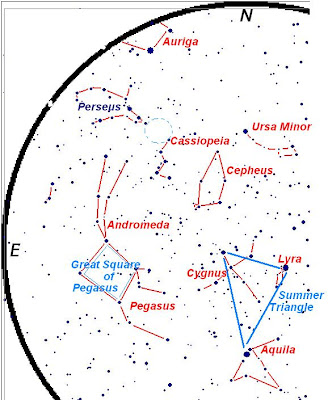
.....Each August, the Earth passes through the remnant trail of the comet Swift-Tuttle, generating the Perseid meteor shower because the radiant of the meteors (the dotted circle in the image below) is in the constellation of Perseus.

.....The Perseid meteor shower does not require a telescope or binoculars; just go outside (especially on the nights of Wednesday, August 11th and Thursday, August 12th, and look to the northeast (especially after midnight).

.....Of the the backyard astronomy I have done, I have a special regard for the Perseid Meteor Shower. Because it does not require special equipment, special practice or special skills, it is easy to share with others. (Also, since observing the Persieds is just looking at the sky, there is no "one person at a time effect that you get with a telescope.) Last year, one of my friends told me about taking his son outside to see the meteors. I've gotten other mail about people who have had their parents show them the meteor shower, and have then shared it with their children. For me, the Perseids were one event I could most easily drag people out to see, often going to visit family with dark skies, or just setting up lawn chairs behind the house, or (one time) my parents even took us to a state park to watch the meteors. For me this gives the Perseids a fairly personal level, especially since my father passed away two and a half years ago. When I would have my telescope at home, it would always be easiest to interest my Dad in coming out and looking at the sky, so there were a lot of times he (and others) would come out, but the Perseids could get everyone out, so its something of a family holiday in my book. I hope that you have the opportunity (weather) to give it a try this year. There will be no bright moonlight those nights, so the sky should be quite dark.

.....Here is a map of the northeastern part of the sky on Thursday at about midnight. Please let me know if you have traditions about the Perseids, or if you have a chance to observe them! If you are in the Winona, Minnesota area, there will be a public observing session at Saint Mary's University of Minnesota. Turn in at the lower gate (across from Goodview Road) and drive straight (i.e., don't make any turns) to St. Yon's Hall. We will set up on the field next to St. Yon's. Bring your own chair/blanket/keep-my-rear-end-dry-device!

Wednesday, July 28, 2010

Objects in Hercules: The Leckenby List Begins

.....The constellation of Hercules is pretty large, sprawling through a fairly dim part of the sky, and it contains of number of excellent deep-sky views. Four of these make good targets even in the light-polluted skies that most of America now has. Two of these appear on Charles Messier's list of Messier Objects, one is a fairly obscure open cluster, and one is a planetary nebula.

.....Let me take a moment to look on the catalogs that we are using. The two globular clusters (the first among many, many of these types of clusters visible during the summer) are best known by their Messier designations, although there a lot of catalogs in astronomy because, hey, there's a lot of stuff. If some new object is identified, generally it is listed in the next catalog instead of bringing the old one up to date (the Messier Catalog itself is an exception to this). The Great Cluster in Hercules is known as M13, NGC 6205, GCI 45, 2MASX J16414163+3627407 (what it gains in precision it loses in convenience), and now (at least as far as this blog is concerned), L1.
Add Image
.....There are, clearly, many different catalogs. Why add one more? What possible use could this "Leckenby List" be? When I first started observing, in seventh grade, with a "telescope" on a tripod that I had to balance on the bar of our chain link fence, I tried to use the Messier Catalog as a guide for objects to find. After all, most of the bright objects in the sky are in the catalog, but not all of them are. I wanted to set up a list that had all the cool things that one could find with a small, suburban telescope, and the Messier Catalog left stuff off that list. There is another Catalog that is of recent vintage, the Caldwell-Moore Catalog, set up to include cool things that Messier left out, but like the Messier Catalog, that also includes objects that are too faint, or too diffuse to be seen in light-polluted skies. The Leckenby List will try to include interesting things that can be seen by a fairly new observer on a perhaps somewhat sketchy night. That's my goal.

.....Globular clusters are actually outside of the disk of our galaxy (while they do orbit the center of the Milky Way), and they consist of some of the oldest stars we can see, forming before the stars in the disk of the Milky Way began to collect.

M 13 or L1

..... The Great Hersules Cluster is one of the two best globular clusters as seen from the continental United States. (If anyone is reading this from southern Florida or Texas, please don't bring uop the much larger and brighter globular cluster Omega Centauri. Thanks.) Tghe Great Hercules Cluster has more than three hundred thousand stars, and it so large that light takes more than 130 years to pass from one edge of the cluster to the opposite edge. It is only that the cluster is at a distance of 23,400 light years that keeps it from appearing even more impressive. M13 is fairly easy to find. Looking at the keystone of Hercules, start with zeta Herculis, one of the stars at Hercules' waist, and scan north. When you are most of the way to eta Herculis, the Hercules Cluster will appear as a fuzzy spot between two stars that sppear brighter than their neighbors. M13/L1 is visible even in bionoculars, which is one reason why I have included it as the first object on the Leckenby List.


As seen in a small telescope, M13/L1 appears as a tight ball of stars, with the stars near the edge (where the density of stars starts to thin out) clearly resolvable as indivindual stars, while the stars near the center blur together). To my view, there are a couple of "arms" of stars that appear a little denser than the other areas (although to be fair, photographs show the stars as pretty uniformly distributed). I would be very interested if there were anyone else out there who had an opinion on whether their own observations showed anything like this.


M92


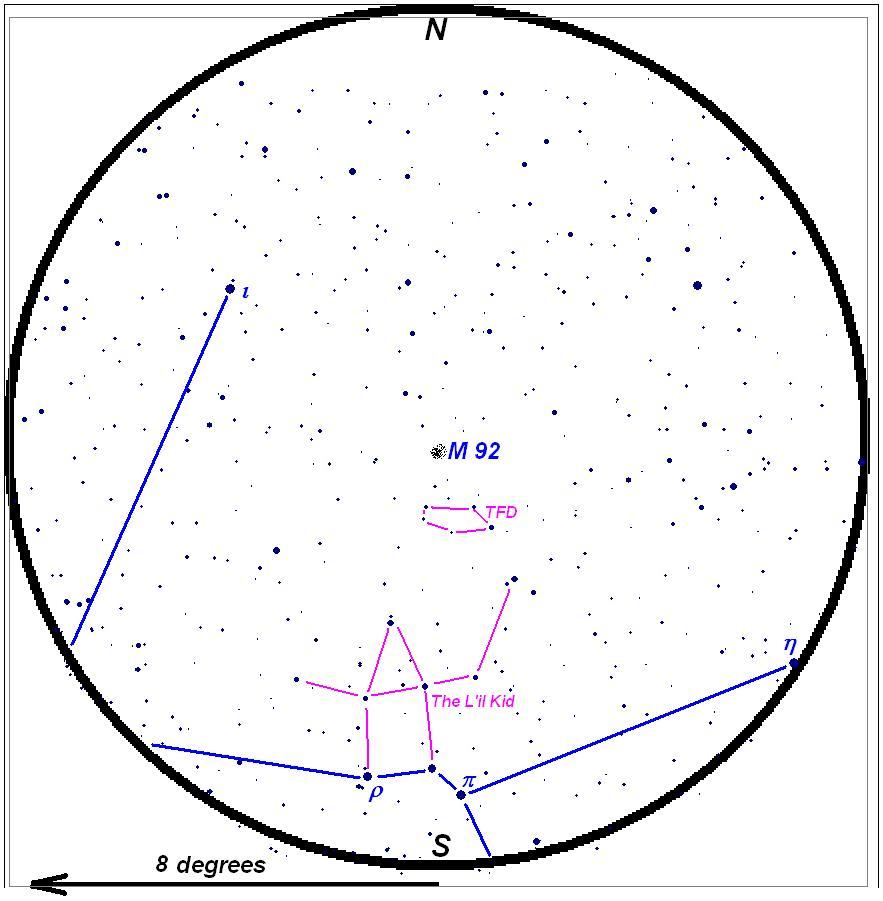
M92 is the other Messier Object in Hercules, and it is also a globular cluster. This can be found fairly easily by starting at the northeast corner of the keystone. If you are looking at this star in binoculars or in a telescope's finderscope, you will see two stars next to pi Herculis, and a set of bright (in binoculars) stars forming an asterism that I christen "the l'il kid" reaching up above his/her head (the existing stars in the star pattern prevent a greater level of detail in the gender of the figure) for the asterism that I name the "Trademarked Fying Disk Toy" (I don't want to get sued), and abovve that, M92 as a ball, these two objects apparently stuck on an invisible roof that the l'il kid just can't reach.


.....Sadly, I haven't observed M92 nearly as much as M13/L1, so I have less of an idea of it's individual observing character. M92 is about two-thirds the apparent size of M13/L1, while only being a little (comparatively) farther away


DoDz 9


.....The next object to look at is a small cluster labeled as Dolidze-Dzimselejsvili 9 is a group of about fifteen stars. Honestly, I do not know if this is an actual cluster of stars that all formed together, or if this is just how it appears. Even the name does not help that much because the DoDz list only has nine objects on it, and the list itself is pretty obscure. Start with the end of Hercules' western arm, and even binolculars should show you this cluster (I think).


.....This is my diagram of this cluster, and I couldn't find a photo or setailed chart to let me know if I was even looking at the right stars. Does someone else have a take on this?


NGC 6210


.....The fourth object is NGC 6210, deriving its lovely, poetic, name from the New General Catalogfrom the 1840's, so called because it replaced the "General Catalog of the 1820's. So there. Nebulae of all types are often hard to see from suburbia as light that is smeared across the sky can be more easily drowned out by the local Wal-Mart (sadly, there's always a local Wal-Mart) that light concentrated into points (stars). Planetary nebula are even more rare because they are the bubbles of ejected gas given off by stars around the same mass as the Sun as those stars finally go the Great Retirement Home in the sky (which is, at least, actually in the sky). These bubbles are often round, as soap bubbles are, and this round(ish) appearance gave them the name "planetary nebulae".
.....I have a finder map for this object that do not have the constellation lines on it because those lines can interfere with finding the object. If you can start from beta Herculis, you should be able to star hop to the nebula, although I don't have .

If you can get to where NGC 6210 shoul be, it should be observable as a small but distinct blue ring, the light concentrated enough to be bright enough to see and just large enough to be identified as a planetary nebula.


Thursday, July 15, 2010

July Sky

.....While I work on the observing maps for some deep sky objects, I don't want to miss the forest for the trees, and so here is a sky map for July. (Constellations that have been discussed on this blog are in blue, and constellations I have not gotten too yet are in red.)

.....The Big Dipper is still in the sky, as it will always be in the sky from the northern US, but some constellations that you can find from the Big Dipper (Boötes and Virgo) are moving off to the west. In the east we can find the Summer Triangle, built using three of the brightest stars in the sky. This set of stars (despite its name) will be in the sky until early winter.

.....This map only includes stars brighter than fourth magnitude, so some stars in the constellations are "missing". If you are just learning the constellations, or if you are viewing from a light-polluted sky, I hope that this will be a better way to find the brighter stars.

.....Start making plans now for the Perseid Meteor Shower! Peaking on the nights of August 11th and 12th, this meteor shower can result in dozens of meteors an hour! This year, the Moon will be out of the sky on these nights, so the sky will be at its darkest. This will hopefully be a great year for the shower!


Tuesday, June 29, 2010

My Delays

.....I haven't gotten a second post up this month, something which was certainly not my plan. Here's my excuse: We went to my granmother-in-law's birthday party, came back, were visited by a good sized chunk of my half of the family for a week, and then went back and visited the in-laws in a more leisurely fashion. Soon (I promise) I will have up a post on things that a small telescope, operating under streetlights, can find and see in Hercules, then a post on the phases of the Moon, then a post on why working for a dark sky is also healthier, more environmentally friendly, and *safer* than sticking street lights every five feet. Then more constellations.

-- Harry

Wednesday, June 2, 2010

Hercules, or "There?", "No, next to it", "There?", "Kinda"


..........Hercules is a constellation of fairly dim stars surrounded by brighter constellations. One might consider just skipping over these stars, but there are some beautiful binocular and telescope objects located in this constellation (the subject of my next post), and these objects make the hunt worth the wait. These objects will also trigger the start of what I am modestly) calling the "Leckenby list". There are many different lists of deep sky objects, the most well known of those being the Messier Catalog, but much of my observing history has been from suburbia, where a lot of even the Messier objects are invisible in a small telescope, and where there are a number of other cool deep sky objects that Messier, for one reason or another, did not see fit to put on his list. There are other lists, such as the Caldwell list, that look at deep sky objects that are in the same range as the Messier list, just not recorded by him, and some bright, wide objects that these lists have considered as too obvious or outside their scope (rim shot), such as double stars. The Leckenby List is my list of cool sky objects that can be seen with a small telescope in suburbia. You don't have to go through what I did, hours of effort to find some object that I've been promised is there, only to discover that I am looking at it, I just can't see it.

.....It is the purpose of a later run through the sky to go into more depth on the story and legends behind the constellations. In any event, I will go under the assumption that if something makes Disney, the basics are fairly well understood.

.....(Although this movie left out Hercules killing his wife and children in a drunken rage. They must be saving that for the sequel.)


.....As far as that goes, if you're going to look for one of the popularizations of Hercules, I'd seek out the Steve Reeves movie versions from the late 1950's. These were brought to my attention by the Mystery Science Theater 3000 versions of Hercules and Hercules unchained, but if your standards are a little relaxed (three beers, or it is 4 AM in the morning, or some such) these movies are as good as any from the era and from the genre. Better than, say, Clash of the Titans (either version).


.....The constellation of Hercules can be found between the constellations of Corona Borealis (or, "The Kite-Eating Tree", if I can get that to catch on) which is relatively easy to find, and the constellation Lyra, easy to find due to the presence of the bright star Vega. (Vega and Arcturus are two of the brightest stars in the sky, and Hercules is roughly between them.) Find the constellation by looking for the two rhomboids that make up the central body of Hercules. The northern one, smaller and a little easier to find, is called the "Keystone", and this will be our starting point for two bright globular clusters in this area.

.....Looking at this, you may find the presence of Hercules less than obvious. That is, looking at this once you finally find it in the sky. (No slight is intended. I've been observing the sky since I was seven, and Hercules is on of those constellations that I have to find, as opposed to just jumping out at me. In fact, on the Mystery Science Theater 3000 episode in which Joel and the 'bots watch the first Hercules movie, they comment on how most of the constellations don't seem to make sense, and Tom Servo attempts to reframe the constellations in terms of modern sensibilities. (You can watch it at this link; the relevant segment starts at about 3:09.) In honor of Tom's work, I'm going to rechristen this constellation into our modern form (joining the Kite and the Kite-Eating Tree) as something that these stars resemble as much as they do any version of Hercules, I give you ...

.

..

...

....

.....

Pablo Picasso's Cubist masterpiece, "Guernica"